

Here’s a scenario many renters have lived: you find an apartment that fits your budget, sign the lease, and then spend the first week making calls to set up electricity, gas, and internet – all while discovering the water bill is somehow in your name and nobody mentioned that. Apartment utilities have a way of sneaking up on you.
This guide breaks down what you’re typically on the hook for, what landlords usually cover, and how to avoid getting caught off guard by either.
TL;DR
Tenants usually set up and pay for their own basic utilities, like electricity and gas. But this is dependent on your landlord and rental property. Some utilities may need additional setup and sometimes utilities are included with certain rental packages. For your best bet, talk to your landlord and thoroughly read your lease agreement.
What Are Utilities in an Apartment?
Utilities are the services that make an apartment livable. Electricity, gas, water, sewer, trash, internet, etc.
There are “hard” utilities, such as the ones the apartment physically can’t function without, like heat, water, and power. Then there are the softer services, like internet and cable, which matter a lot in practice but are technically optional and appear on leases inconsistently.
What counts as a utility bill also shifts by region. In some cities, trash pickup is a municipal service folded into property taxes and you never see a separate bill. In others, it’s a line item you pay monthly.
What most renters really want to know is which utilities come with the apartment and which ones they’re signing up to manage themselves. That answer varies more than it should.
Standard Apartment Utilities: A Quick Breakdown
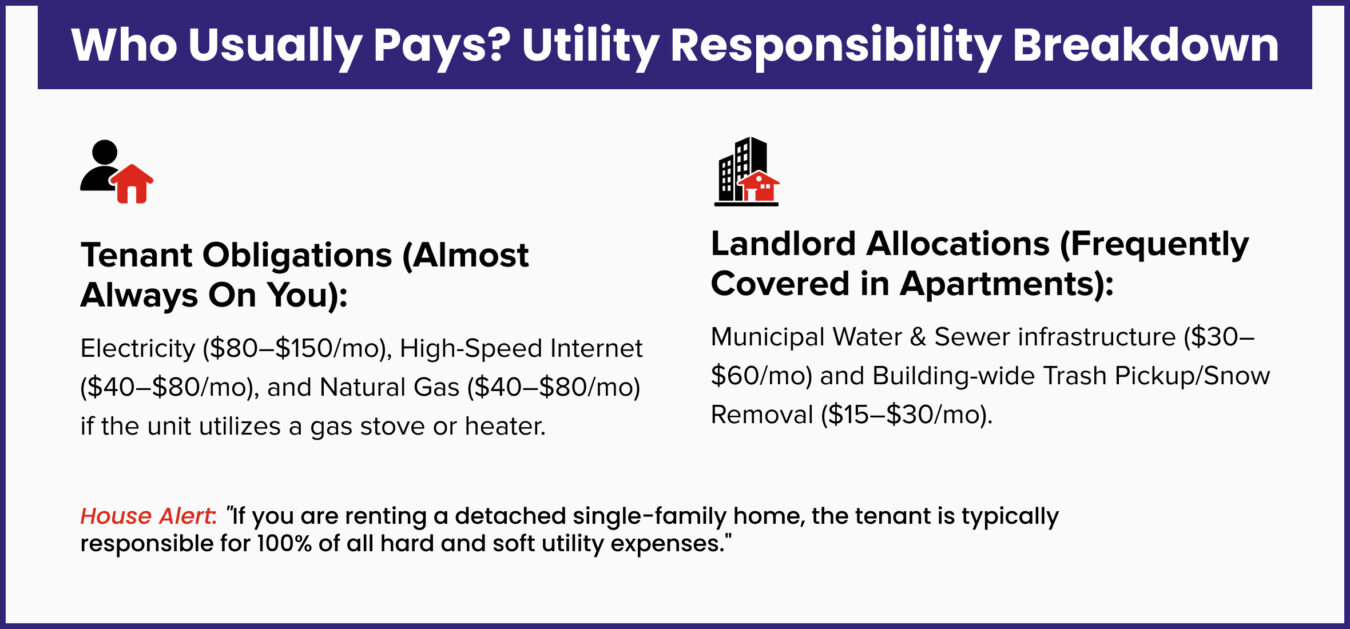
Electricity is the one almost every renter pays directly – billed monthly, it averages $80-$150 depending on climate and unit size. Gas is similar: if your unit has gas heat or a gas stove, expect a separate account with the gas company, which is typically $40–$80 a month.
Water and sewer are trickier. In a lot of multi-unit buildings, these get wrapped into rent, but plenty of landlords bill them separately, usually totaling $30-$60 a month. Trash follows a similar pattern: it’s often a building-level service, occasionally a line item.
Internet is almost always on you unless your building has a bulk deal with a provider.
Another note: amenity fees and pet rent aren’t utilities, even when they’re listed nearby in your lease. They’re just additional rent.
Are Utilities Included in Rent?
It really depends on the landlord and the property type – there’s no universal rule.
The all-inclusive setup, where rent covers literally everything, does exist but it’s uncommon. When you do find it, the base rent is almost always higher to account for it.
More typical is a partial arrangement where the landlord handles water, sewer, and trash while you’re responsible for electricity, gas, and internet.
The third version is tenant-pays-all, which shows up most often in single-family rentals and smaller properties where every utility is separately metered and billed.
When a listing says “utilities included,” it’s worth asking exactly which ones before you get excited about it. That phrase has covered everything from all utilities to just trash pickup, depending on who you’re talking to. If a landlord mentions a utility allowance – meaning they cover costs up to a set amount and you pay anything over – get that in writing.
Our rental application guide has more on what questions to ask and when.
Utilities Typically Included
If your landlord covers some utilities, the most likely candidates are water, sewer, and trash. The reason is unglamorous: in buildings with shared infrastructure, these run on a single meter or contract. Billing twelve apartments separately for one water line is complicated, so landlords absorb it and build it into rent.
Electricity and gas almost never make that list—individual usage varies too much for landlords to absorb. The thing that trips people up is confusing non-utility fees for utilities. Pet rent, parking, gym access—these sometimes appear right alongside utility charges in your monthly breakdown, but they’re not utilities. They’re just fees, and they don’t count when a building advertises “utilities included.”
Which Utilities You’ll Almost Always Pay For
Short version: electricity and internet. Those two are yours in almost every rental situation.
- Gas follows if your unit uses it. Not every unit does; plenty of newer buildings are all-electric, which simplifies things.
- Internet is essentially always a tenant choice and expense unless the building has worked out a deal with a provider, which does happen but isn’t the norm.
Single-family rentals are worth calling out specifically. When you rent a house rather than an apartment unit, it’s common to be responsible for everything. A house with lower rent than a comparable apartment might actually cost more per month when utilities are factored in. That comparison is worth doing before you commit.
How Apartment Utility Bills Are Calculated
Most people assume their utility bill reflects what they personally used. That’s true when your unit has its own meter, but a lot of multi-unit buildings use something called RUBS, which stands for Ratio Utility Billing System.
In a RUBS situation, the landlord gets one bill for the whole building, then divides it among tenants based on some formula – usually square footage or occupancy. This is legal in most states, but renters are often surprised by it when they first encounter it.
Sub-metering sits in between: landlords install individual meters per unit, but they handle the billing themselves rather than the utility company. Your bill reflects your usage, but it goes through the landlord rather than directly through the provider.
Before you sign anything, just ask: how are utilities billed here? It takes thirty seconds and can save you from some real sticker shock later.
Setting Up Apartment Utilities When You Move In
This is the part that’s easy to push off and then regret. If you’re responsible for setting up your own utilities, do it before move-in day – not the day of. Here’s how we recommend getting started.

1. Start by finding out which providers serve your address. Your landlord can usually tell you, or the provider’s website will have a service-area lookup.
2. Schedule activation dates to line up with your move-in, and ask upfront whether a deposit is required—first-time renters with no account history often get hit with one.
3. When you actually move in, photograph your meter readings. It sounds like overkill until you get a bill that seems off and need to prove your starting point.
4. Also, check your lease for any clause requiring you to set up tenant-paid utilities within a certain window after move-in. Some landlords include that and will flag it if you don’t.
For a broader look at getting set up in a new place, our furnishing your apartment guide has useful early-days advice.
Average Cost of Apartment Utilities
Here are some ballpark numbers for a typical apartment, nationally:
- Electricity: $80-$150/month
- Gas: $40-$80/month
- Water and sewer: $30-$60/month when billed separately
- Internet: $40-$80/month
- Trash: $15–$30/month, if it’s not covered
All in, you could be looking at $205-$400 a month if you’re paying everything yourself.
Climate and building age can pull that number in either direction. If you can, ask current tenants what they actually pay – that’s more useful than any national average. Saving 10-20% of rent for utilities is a rough baseline if you have nothing else to go on.
How to Lower Your Apartment Utility Bills
A few things actually move the needle.
- LED bulbs are genuinely worth switching to, since they use a fraction of the electricity of older bulbs. Unplugging electronics when not in use helps too.
- Use cold water for laundry, and run full loads only
- Running the dishwasher rather than hand-washing dishes (counterintuitively, dishwashers usually win on water use)
- For heating and cooling, a smart thermostat is the biggest lever if your landlord allows installation.
- Internet is worth revisiting once a year, since promotional periods end and rates quietly climb. Check what else is available at your address and call to renegotiate if something better exists.
If your bills are running high and it feels like the unit is working against you, that’s a landlord conversation. Building issues that spike your costs are their responsibility to fix, not yours to absorb. Our rental property damage guide breaks down where those lines fall.
Frequently Asked Questions About Apartment Utilities
What utilities do you pay for in an apartment?
Electricity and internet, almost always. Gas if your unit uses it. Water, sewer, and trash depend on your building, since those are often covered in multi-unit properties, but not always. Read the utilities section of your lease before signing; it should spell this out.
How much should I budget for utilities each month?
If you’re paying everything yourself, somewhere in the $200–$400 range is realistic for a typical apartment. Climate and building age pull that number in either direction. A rough rule of thumb is 10–20% of rent—imperfect, but useful as a starting baseline when you’re comparing options.
Are utilities ever included in rent?
Yes, but how much varies a lot. Water, trash, and sewer are the most commonly included items, especially in multi-unit buildings. Electricity and gas rarely are.
What happens if I don’t pay an apartment utility bill?
If the account’s in your name and goes unpaid, it can end up in collections and show up on your credit report. The utility company can also disconnect service. Some leases require tenants to keep utilities active – if yours does and you let an account lapse, that’s potentially a lease violation on top of everything else.
Can a landlord cut off utilities to force me out?
No, and doing so is illegal in virtually every state. Shutting off electricity, water, or heat to push a tenant out is considered constructive eviction, which exposes the landlord to serious legal liability regardless of any payment dispute or lease disagreement. If it happens, document everything and contact a local tenant rights organization.
Do I need renters insurance to cover utility damage?
Renters insurance covers your personal belongings if they’re damaged by something like a burst pipe, not the pipe itself or the building. It won’t pay your utility bills, and structural damage is the landlord’s domain. What it does protect is your stuff in those situations, which is worth having. Our apartment life blog has more on what renters are and aren’t responsible for.