


An eviction on your record doesn’t make renting impossible. It makes it harder – sometimes, a lot harder – but people do it all the time. Landlords who will work with you exist. They’re just not always the ones showing up first in your search results.
What actually matters is understanding where to focus your energy, what these landlords care about, and how to present yourself in a way that makes the eviction less of the story than your current situation. That’s what this is about.
What Counts as an Eviction on Your Record?
Here’s something worth clearing up: not every bad rental ending becomes a formal eviction.
- A real eviction is a court process. The landlord filed, a judge ruled, and you were legally required to leave. That’s what shows up on tenant-screening reports.
- Cash-for-keys deals, where a landlord pays you to leave without filing, typically don’t appear on your record. Same with voluntary move-outs, even messy ones.
- A “pay and stay” situation where you caught up on rent and the case got dropped is murkier; some screening databases report any filing, dismissed or not.
Evictions can surface in court records, tenant-screening databases like Experian RentBureau or LeasingDesk, and sometimes your credit report if the unpaid debt went to collections.
How Long Does an Eviction Stay on Your Record?
Seven years for most tenant-screening reports. Court records are a more frustrating situation. Depending on the state, those may stay publicly accessible long past when the screening database dropped it, sometimes indefinitely.
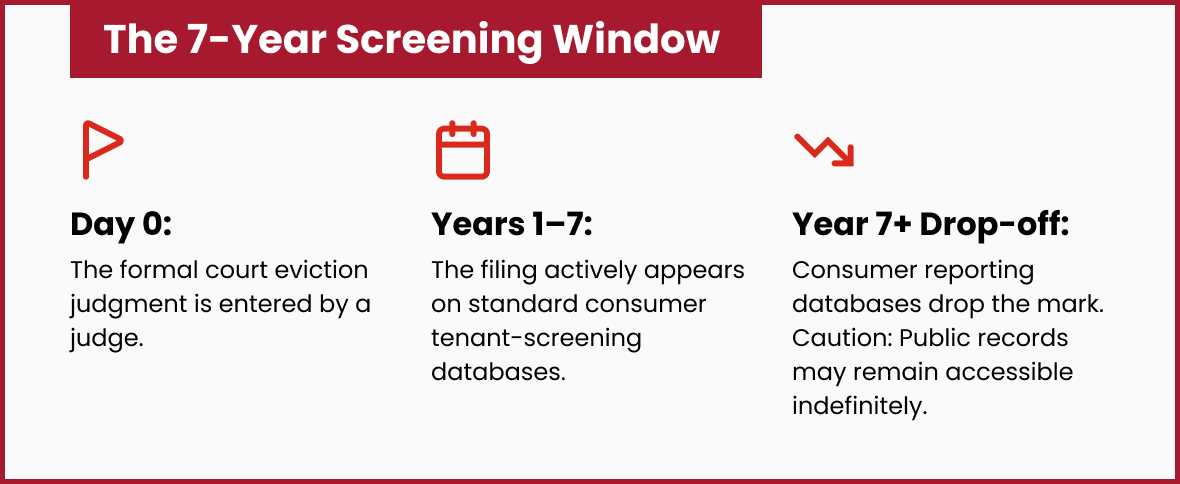
Getting it removed early is genuinely difficult. Expungement is possible in some states for dismissed cases or ones you won, while record correction may apply if the filing was a genuine error. Some states have passed specific tenant protection laws with additional pathways.
Pursuing these approaches may be successful, but will not be quick.
Pro Tip: Paying off the debt doesn’t remove the court record. It settles the money side of things, and you should document it, but that’s a separate issue from the legal filing itself.
Who Tends to Accept Tenants with Evictions?
There’s no centralized list of apartments that accept evictions. What you can find more easily is a clear pattern that will identify which type of landlord is more likely to work with you.
Corporate property management companies (the ones running large complexes) almost always use automated screening software with preset cutoffs. An eviction triggers a flag, the system declines the application, and often no human is involved in that decision at all. Appealing it is usually a dead end.
Smaller operators work differently. These may include:
- A private landlord managing a few units
- A local property management company without a corporate screening policy
- A mom-and-pop owner who’s been renting out the same duplex for fifteen years.
These people actually look at applications, and can weigh the eviction against when it happened, why it happened, and what your situation looks like right now.
Private Landlords vs. Large Property Management Companies
To be blunt, large property management companies may not be helpful for you right now.
Their screening is automated, their criteria are set at the corporate level, and individual leasing agents often have no authority to override a decline. A recent eviction, in most of these systems, is simply a hard no.
Private landlords who accept evictions are worth focusing on because they can actually see and evaluate you. A landlord who owns three units and reviews her own applications can decide that an eviction from four years ago during a medical crisis, combined with your current stable income and a reference from your last landlord, adds up to an acceptable risk. That calculation is impossible within an automated system.
Second-Chance Rental Programs and Subsidized Options
Second-chance rentals are properties that specifically market to renters with evictions or credit problems. They still screen, but the criteria are built to give people a realistic shot rather than filter them out automatically.
Section 8 vouchers also meaningfully change the math for landlords. Since the government is covering a significant chunk of rent, it reduces what the landlord is risking on you personally. That doesn’t erase eviction history from consideration, but it may make some landlords more willing to look past it. If you don’t have a voucher but might qualify, contact your local housing authority about waitlists. They’re long in most places, but getting on one costs nothing.
Also, it’s important to note that people with eviction histories are common targets for rental scams. If somewhere advertises that they “accept all evictions” for an upfront approval fee, that’s a scam, not a second-chance program. Verify everything through county property records before sending money anywhere.
How to Strengthen Your Apartment Application

You can’t rewrite the past, but you can make the rest of your application genuinely strong. Here are some suggestions for where to start.
- A larger security deposit is the most direct lever – offering an extra month or two upfront signals stability and reduces the landlord’s perceived risk in a concrete way. A co-signer with solid credit does something similar. Not everyone has someone who can do that, but if you do, it’s worth offering.
- Income documentation matters more here than in a standard application. Pay stubs, bank statements, an offer letter if you’ve recently started a job – anything that shows financial stability now. Most landlords want to see income at 2.5 to 3x monthly rent, and demonstrating that clearly reduces the weight the eviction carries in the decision.
- Pull your own tenant-screening report before applying anywhere. Know what’s on it and dispute any errors so it’s as clean as possible going into the application process.
- Gather references from the time since the eviction – a subsequent landlord, an employer, anyone who can speak to your current situation. Even 12 to 18 months of on-time payments somewhere documents a story that a screening report alone can’t tell.
Our guide to applying for a property online covers the practical mechanics.
How to Talk About Your Eviction Honestly
Most people’s instinct is to stay quiet and hope it doesn’t come up. That strategy almost never works.
A short cover letter addressing the eviction directly is almost always the better move. Not a long explanation, not a defensive one. Just a simple explanation: here’s what happened, here’s what’s different now, here’s what I can show you. Three sentences can be enough. What you’re doing is giving the landlord a clear way to understand the record instead of just reacting to it.
The framing also matters. “I fell behind on rent after losing my job in 2021 and couldn’t catch up in time” is a different sentence than leaving a landlord to assume the worst. Bring documentation if you have it – proof of payment if you’ve settled the debt, court paperwork if the case was dismissed, or a reference from a subsequent landlord if you’ve rented since.
Make sure to have this conversation by phone or in person when you can. It’s so much easier to build credibility as a human being when you’re face-to-face.
Can You Get an Eviction Removed from Your Record?
Sometimes yes, and it’s worth finding out whether your situation qualifies.
Expungement (sealing or erasing the court record) is available in some states for dismissed cases, cases the tenant won, or cases that meet certain age requirements. It’s not available everywhere and the process varies.
Record correction is different: if the eviction was filed against the wrong person or contained factual errors, you can petition to fix it. This tends to move faster.
Paying off the debt doesn’t remove the record. It’s 100% worth doing and documenting, but the filing stays until you go through a formal removal process.
For state-specific guidance, contact the court where the eviction was filed or a local tenant advocacy organization.
Red Flags to Avoid When Apartment Hunting with an Eviction
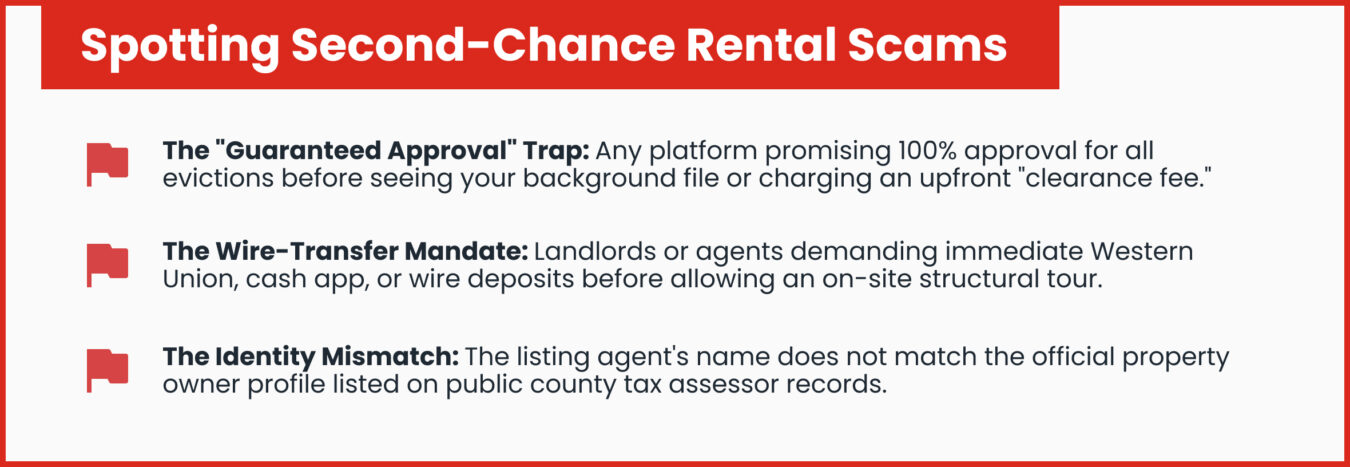
When your options feel limited, warning signs are easier to overlook. That’s exactly what scammers are counting on. Llistings promising guaranteed approval for renters with evictions in exchange for an upfront fee are a scam. Second-chance programs are real, but legitimate ones don’t charge you before you’ve seen a unit. The same goes for landlords who insist on wire transfers, won’t let you tour before a deposit, or pressure you to decide today.
Before handing over money, look up the property in county records to confirm the person you’re dealing with actually owns it. If the same listing is floating around under different names on different platforms, walk away. Searching through an established platform like Rentler cuts down on your exposure and puts you in front of private landlords and smaller operators most likely to actually consider your application.
Frequently Asked Questions About Renting with an Eviction
Can you rent an apartment with an eviction on your record?
Yes, though it takes more effort and more targeting. Large corporate apartment complexes are largely a dead end, since their automated screening makes it close to impossible. Private landlords, smaller management companies, and second-chance programs are where apartments that work with evictions actually exist.
What states are best for renting after an eviction?
California, New York, and Minnesota have all passed laws limiting how landlords can use eviction history in screening. A few other states are moving in that direction. Within states, city-level rules sometimes go further than state law. A local tenant advocacy organization can tell you exactly what applies where you’re looking.
Do all landlords run eviction checks?
Most do. Large property management companies almost universally run formal screening reports that include eviction history. Smaller private landlords vary. Our rental application fees guide explains what standard screening typically covers.
Will paying off my old rent balance remove the eviction?
No. The debt and the court record are separate things. Paying settles the money (which you should do and document), but the eviction filing stays on your record until you go through expungement or a correction process.
How much extra deposit might I need to pay?
Anywhere from one to two months extra is common, though it depends on the landlord and what state law allows. Some states cap total deposit amounts, so a landlord can’t ask for unlimited upfront money even if they want to. Know your state’s rules before you agree to anything – and if a landlord is asking for an amount that seems extreme, check whether it’s actually legal where you are.
Can I rent if my eviction was during the COVID moratorium?
Possibly, and it’s worth checking before assuming the worst. A number of courts dismissed moratorium-era cases or sealed those records, and some local laws specifically limit how landlords can use pandemic-period evictions in screening. Pull your actual court records and find out what’s documented. You may be in a better position than you think.