
Proof of Income for an Apartment: Documents Landlords Accept
When you set out to find an apartment to live in, landlords and property management companies will need to verify that you can pay the rent. It’s one of the first items they’ll look at to find out if you qualify to rent a unit. This is where you would need to show proof of

Nadiia
10 min read

When you set out to find an apartment to live in, landlords and property management companies will need to verify that you can pay the rent. It’s one of the first items they’ll look at to find out if you qualify to rent a unit. This is where you would need to show proof of income.
In this Rentler guide, we’ll explore the most common documents you can use to show proof of income and verify your earnings below.
TL;DR
Landlords typically require proof of income before approving a rental application — usually documents showing you earn at least 2.5 to 3 times the monthly rent. What you’ll need depends on how you earn: salaried employees can usually get by with recent pay stubs and a W-2, while freelancers, gig workers, retirees, and students may need to provide more.
What Is Proof of Income?
Proof of income is any document a landlord uses to verify how much money you earn and how reliably you can earn it.
In most cases, you’ll need to show that your monthly income is at least two and a half to three times the rent. Landlords want to see “verifiable income,” so you’ll need to confirm wages or other earnings through a third-party, like an employer, government, or your bank statements. Income verification is a fundamental part of any rental application process.
Depending on how you make a living, you may need to submit different documents than someone who earns differently. For example, employees who have been at the same job for years may only need to submit recent W-2 forms or pay stubs, which tends to be pretty straightforward. Gig workers may need to collect and submit more complex documentation.
The Most Common Proof of Income Documents
Applying for a rental, you will likely need to fill an application form with your contact, income, and rental history information. Then, you will likely have to pay a rental application fee and turn in your documents that prove the information in the application is correct.
There are standard documents that most landlords tend to accept as proof of income for apartment rental.
These include:
- Pay stubs from the last two to three months
- W-2 tax form from the most recent year
- Bank statements showing direct deposits
- Employer offer letters (for new hires)
- 1040 tax return with a W-2 form attached
- Other documents, including Social Security benefits
Pay stubs have long been, by far, the most common document that prospective renters submit. However, people who are self-employed or attending college still manage to rent apartments every day.
Furthermore, some landlords will accept a single document while others may ask for a stack to cross-check your income source(s). The rules for what a property manager can ask for may vary between jurisdictions across the United States.
In some cases, poor credit or debts could change a tenant’s income calculations or ability to qualify for an apartment. If your credit history may need work or is , learn how to rent an apartment with bad credit or how to get an apartment with no credit.
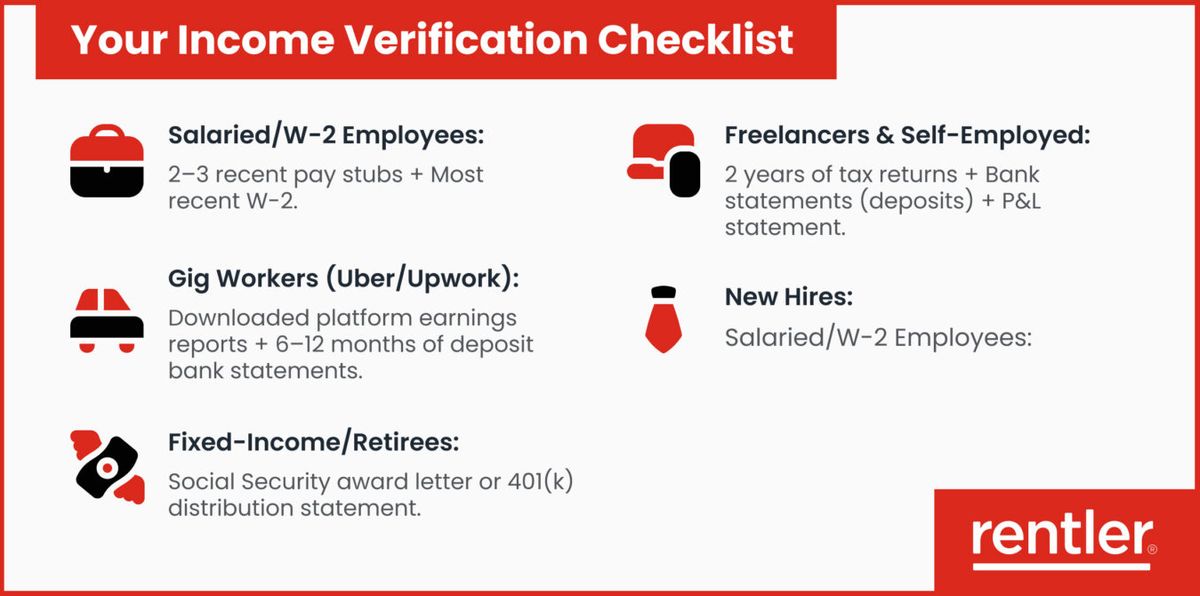
Proof of Income for Salaried Employees
Full-time, salaried employees may have the least complicated means to verify income for an apartment rental.
When verifying earnings, most landlords will simply ask for:
- Two to three of an employee’s most recent pay stubs.
- The latest year’s W-2 form(s) submitted to the IRS.
Pay stubs should show the prospective renter’s gross income, employer information, and the date range for the earnings. Some landlords will call the company’s Human Resources (HR) line to verify employment.
To make sure documents are submitted in a timely manner, bring the property manager physical copies of the documents or submit PDF copies. If you promise to “email later,” your application could sit incomplete.
Proof of Income for Self-Employed and Freelancers
For self-employed earners and freelancers, the income verification process may be more complex than for salaried workers. In general, landlords can accept a range of documents.
Some proof of income examples for freelancers or self-employed include:
- The most recent two years of tax returns.
- Recent 1099-NEC forms from clients.
- Profit & loss statements.
- Bank statements that show income deposits.
Some landlords may accept a CPA letter that confirms annual self-employment income.
Property managers can tend to be more skeptical of self-employed income because it isn’t as familiar, and they may believe it’s easier to fake. So, come prepared with plenty of clear documentation. It might help to show consistent income across multiple years if possible.
Proof of Income for Gig Workers
Many popular gig work platforms have built-in earnings reports. Uber, Lyft, DoorDash, Instacard, Upwork, and Fiverr all offer easy-to-access, instant, downloadable earning statements. So, if you work for one or more of these companies, take advantage of this feature and print or save your statement(s) in PDF format. Then, you can submit it with your application.
It can help to accompany any earnings statements with bank statements that show deposits made from the platform for additional evidence.
Some landlords also accept 1099-K or 1099-NEC forms. These tax forms can help verify income earned through freelance work, independent contracting, gig apps, or online sales platforms.
It may be a good idea to assemble at least six to twelve months of consistent earnings reports when applying for an apartment.
Proof of Income for New Hires
If an employer made you a formal offer letter on company letterhead that shows your salary and start date, as a new hire, this can usually work as income verification for an apartment rental application. However, landlords may then ask for a follow-up W-2 or pay stub after you’ve started.
So, if you will be relocating or apartment hunting soon after accepting a new job, it can be a good idea to ask the HR department for this letter as soon as you’re hired. Some landlords will accept an employment verification letter directly from HR.
Retirees and Fixed-Income Renters
If all or some of your earnings include fixed-income like social security, pension, or annuity payments, your documentation will vary from other types of earners.
In this case, proof of income examples can include:
- Social Security award letter
- Pension statement
- IRA or 401(k) distribution letter
- Annuity confirmation
The Social Security Administration provides downloadable benefits statements online. Fixed-income earners may want to supplement their income verification with bank statements that show the deposits.
To show stability, consider submitting at least twelve months of statements.
Students and Part-Time Workers
Students and part-time workers with limited or no income, irregular hours, or those with scholarship or grant income may need to jump through more hoops to rent an apartment.
Acceptable income verification documents for students and part-time workers might include:
- Financial aid award letter
- Scholarship or grant letter
- Parents’ tax returns (if they agree to cosign)
- Bank statements that show regular deposits
Because of age or limited rental history, students often need a guarantor or cosigner regardless of their income. Be prepared to be transparent about the source of funds that will be covering rent.
If you have no income at all, explore ideas for apartment hunting while unemployed.
How Much Income Do Landlords Want to See?
Landlords and property managers tend to want to see verifiable income that meets or exceeds two and a half to three times the monthly rent amount.
So, if the cost of the rental is $1,000 per month, and the landlord wants to see three times the earnings, you’ll need to show that you and any other tenants earn at least $3,000 in gross income per month, in most markets.
Requirements can vary. In New York City, the standard is higher – New Yorker landlords may want to see 40 to 50 times the monthly rent in annual tenant earnings. Some buildings may require even higher income thresholds. Combined household income may count for co-applicants, depending on the property’s policies.
If an applicant does not meet the income requirement, some landlords may approve the application with a guarantor or cosigner.
When property management professionals ask for income, they usually mean gross income before taxes and other deductions, not take-home pay.
How to Show Proof of Income for an Apartment
If you’re wondering how do you show proof of income when renting an apartment, the process is usually straightforward. Start by gathering documents that verify your earnings, such as pay stubs, tax returns, bank statements, employment letters, or earnings reports from gig work platforms.
Save each document as a PDF and use clear file names, such as “PayStub_May2026.pdf” or “BankStatement_April2026.pdf.”
When you apply for a property online, you’ll typically upload these documents with your rental application.
Keep in mind that landlords may request more than one type of proof of income. They may also contact your employer to verify your employment and earnings by phone.
It’s smart to have backup documentation ready in case your employer, client, or other primary verification source is slow to respond.
Red Flags Landlords Watch For
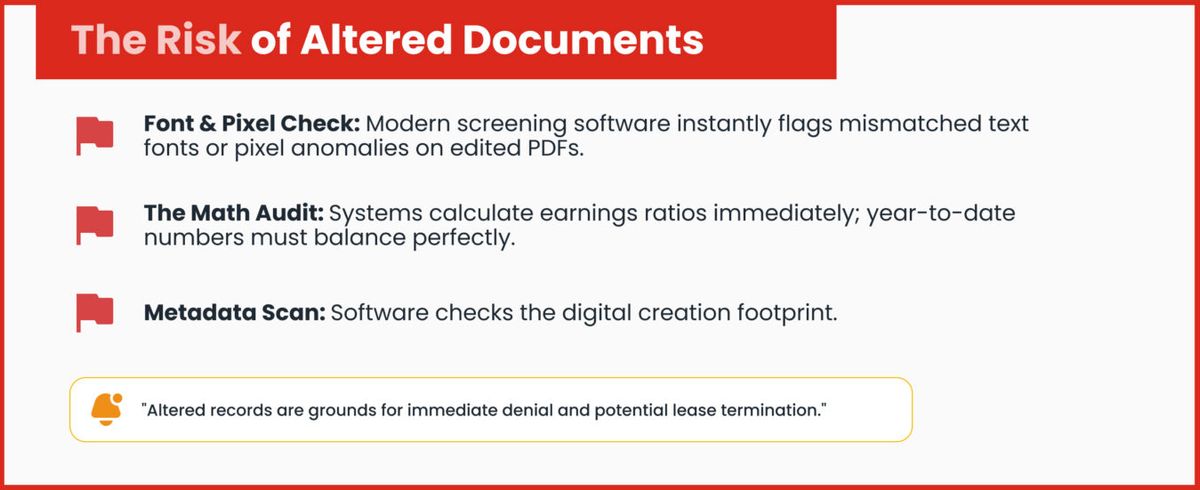
To protect themselves and their properties, property management teams and landlords are on the lookout for common red flags.
Some of the things they look for are:
- Large, recent deposits with no obvious source
- Documents that don’t match application information
- Expired identification
- Doctored pay stubs
Fake or altered pay stubs are one of the greatest risks for landlords, and they usually know how to spot them. Many also use third-party verification services to check authenticity.
So, be completely transparent. Gaps and irregularities in your income are far less concerning than being caught with inconsistencies. And, if discovered later, lies on a rental application can be grounds for lease termination or eviction if discovered later.
Frequently Asked Questions About Proof of Income
What is proof of income for an apartment?
Proof of income is documentation that shows you earn enough money to pay rent. Landlords use it to verify your financial ability to meet monthly housing costs. Common examples include pay stubs, tax returns, bank statements, employment verification letters, Social Security award letters, and self-employment income records.
What if I don’t have pay stubs?
If you don’t have pay stubs, you may still qualify for an apartment by providing other forms of income verification. Many landlords accept tax returns, bank statements, employment letters, benefit award letters, profit and loss statements, or earnings reports from freelance and gig work platforms. Requirements vary by property.
Are bank statements enough for proof of income?
Sometimes, bank statements can help verify income, especially for self-employed workers, freelancers, retirees, and gig workers. However, many landlords prefer to see additional documentation that explains the source of deposits. Combining bank statements with tax forms, earnings reports, or employment records can strengthen your application.
How recent do pay stubs need to be?
Most landlords prefer recent pay stubs from the last 30 to 60 days. Some may ask for your two or three most recent pay stubs, while others request several months of records. Providing the most current documents available can help prevent delays during the application review process.
Can I use a job offer letter as proof of income?
Yes, some landlords accept a job offer letter as proof of income, particularly if you recently changed jobs or have not received your first paycheck yet. The letter should typically include your position, start date, salary, and employer contact information so the landlord can verify details.
What is verifiable income?
Verifiable income is income that a landlord can confirm through documents or third-party sources. Examples include wages reported on pay stubs, deposits shown on bank statements, government benefits, pension payments, freelance earnings, and income reported on tax forms. The key requirement is that it can be verified.
Share this article
More articles
 Tenants
How to Rent an Apartment: Total Step-by-Step Guide
Figuring out how to rent an apartment or house for the first time can be an exciting and overwhelming experience. To make the process as easy as possible, it’s important to be prepared and to know what to expect. Getting Started: Renting an Apartment for the First Time Renting your first place is a major
Anna L.
 Tenants
What Do Apartments Look For in Background Checks?
If you’re currently apartment hunting, you know it’s common to send multiple applications before finding the right apartment and moving in. With each application, you also generally submit a background check and pay an application fee at some point. But what do apartments look for in background checks? And why do they need to do
Nadiia
 Tenants
Locked Out of Your Apartment? Here’s What to Do
Getting locked out of apartment buildings is scary, especially late at night. Panic is a common response, but it usually doesn’t help the situation, and it can make it more difficult to think clearly. In this guide from Rentler, you’ll find step-by-step instructions for if you’re locked out of the house: what to do, who
Nadiia